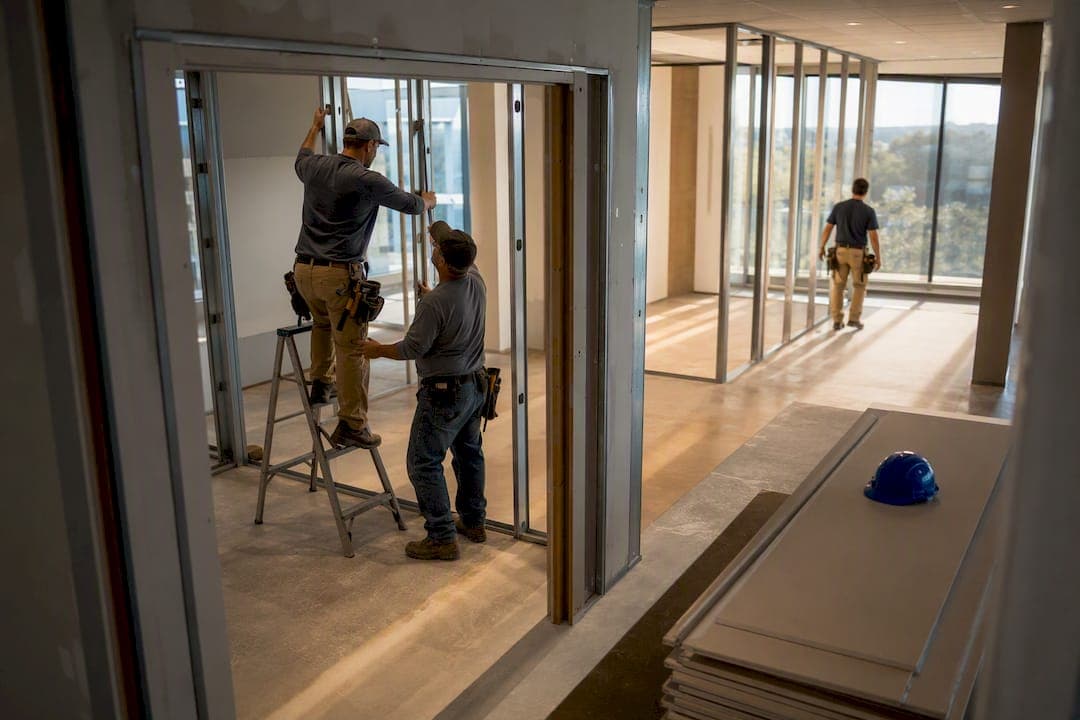
A tenant improvement allowance (TIA) is the dollar amount, usually expressed per rentable square foot, that a landlord contributes toward building out a commercial space for a new tenant. Before you sign anything, check the work letter for exactly which costs qualify, when draws get paid, and what happens to unused funds. With fit-out costs climbing in 2026, that fine print now matters more than the headline number, and it connects directly to accounting treatment under ASC 842 and tax rules from the Internal Revenue Service (IRS).
TL;DR:
- The allowance should be based on a detailed contractor bid, not just a per-square-foot estimate, to accurately assess affordability.
- Clear documentation of eligible costs, including soft costs like permits and design fees, is essential to avoid unexpected expenses.
- The total build budget must include hard costs, soft costs, contingency, and IT cabling, with comparisons made against the allowance pool to identify funding gaps.
- Payment structures, such as reimbursement, turnkey, or amortized allowances, significantly impact cash flow and control over the construction process.
- Increasing 2026 costs mean allowances are less effective as fixed dollar amounts, requiring market-specific benchmarking and precise negotiation tactics.
Table of Contents
- Understanding Tenant Improvement Allowances (What TIA Means and Who Pays)
- What Counts Toward the Allowance (and What Gets Left Out)
- How to Calculate Your Allowance and Build a Real Budget
- Reimbursement, Turnkey, or Amortized: How the Money Actually Moves
- Negotiating a Tenant Improvement Allowance That Actually Works for You
- Accounting and Tax Treatment: What ASC 842 and the IRS Say
- Turning the Allowance Into a Finished Space: A Contractor's Checklist
- What 2026 Fit-Out Costs Mean for Your Allowance
- Building With a Partner Who Protects Your Allowance
- Sources
- FAQ
Understanding Tenant Improvement Allowances (What TIA Means and Who Pays)
A tenant improvement allowance, also called TI, a build-out allowance, or improvement allowance, is landlord-funded money set aside to construct or renovate a commercial space to a tenant's specifications. Landlords offer it because an empty shell rarely attracts a tenant willing to sign a five or ten-year lease. Tenants want it because fronting six figures in construction costs before you have moved a single desk is a rough way to start a lease.
The relationship works both directions. Landlords treat the allowance as a capital investment that helps them win a signed lease and, often, a higher effective rent over the term. Tenants treat it as a way to reduce upfront cash outlay, even though the cost typically gets baked back into rent one way or another.
That is why a TIA never stands alone in the numbers. It sits alongside other concessions, and comparing two lease offers without accounting for all of them is a common negotiation mistake.
- Free rent periods offset early cash flow the same way a TIA does, just on the rent side instead of construction.
- Base rent level often rises when the TIA is generous, so a bigger allowance is not automatically a better deal.
- Lease term length typically drives allowance size, since landlords amortize the cost over the years they expect to collect rent.
Comparing offers on TIA per square foot alone misses the real math. CompStak recommends a concession-ratio approach instead, covered in the calculation section below.
What Counts Toward the Allowance (and What Gets Left Out)
Work letters draw a line between hard costs, soft costs, and items that rarely qualify at all. Knowing which side of that line each expense falls on before you negotiate saves you from discovering a $40,000 gap after demolition starts.
Hard costs almost always included:
- Interior partitions and demising walls
- Ceiling grids, tiles, and lighting fixtures
- Flooring, paint, and millwork
- Electrical distribution and HVAC ductwork tied to the space
Soft costs that get disputed more often than they should:
- Architectural and engineering fees
- Permit fees and code compliance work
- Construction management or project management fees
- Low-voltage cabling for IT and audio-visual systems
Common exclusions tenants should watch for:
- Furniture, fixtures, and equipment (FF&E) not attached to the building
- Tenant-specific trade fixtures, like restaurant kitchen equipment or medical imaging machinery
- Moving costs and signage in most standard work letters
Landlords sometimes resist including soft costs because they are harder to cap and easier to pad. A tenant with leverage, whether from strong credit or a competitive submarket, can often negotiate soft costs into the eligible list, especially architectural fees and permit costs.
Pro Tip: Ask for an itemized "eligible costs" exhibit attached to the lease, not just a paragraph reference to "improvements." A specific exhibit prevents arguments six months into construction over whether your server room cabling qualifies.
How to Calculate Your Allowance and Build a Real Budget
The math behind a TIA starts simple: multiply the allowance rate by your rentable square footage (RSF), not usable square footage, since that's the basis landlords quote from. A landlord offering $50 per RSF on a 5,000-square-foot suite is putting $250,000 on the table, expressed as $50 × 5,000 RSF according to LeaseAbstractors. The gap between that pool and your actual build-out cost is where deals get made or broken.
- Calculate the allowance pool. Allowance rate per RSF × total RSF = total TIA dollars available.
- Build an all-in budget. Add hard costs, soft costs, a contingency (commonly 10 to 15% of hard costs on commercial fit-outs), furniture, and IT/AV cabling. JLL's fit-out cost guides break these components down by market and are worth pulling before you finalize a number.
- Compare the bid against the pool. If your general contractor bids the buildout at $310,000 against a $250,000 allowance, you have a $60,000 gap to cover through cash, a rent adjustment, or value engineering.
- Check the surplus clause. If the bid comes in under the allowance, some work letters let you apply the difference to rent credits or additional scope; many others simply forfeit the unused portion, so this clause deserves specific attention before you sign.
- Run the concession-ratio check. Add TI plus the dollar value of free rent, divide by total lease value over the term, and compare that percentage across competing offers rather than comparing raw TI numbers side by side.
That last step matters more than most tenants realize. A $45 per square foot allowance with two months free rent on a seven-year term can outperform a $60 allowance with no free rent, depending on how the math shakes out. CompStak's concession-ratio method exists specifically to catch that kind of trap.
Reimbursement, Turnkey, or Amortized: How the Money Actually Moves
The allowance amount is only half the story. How it gets delivered shapes your cash flow and how much control you keep over the project.
- Reimbursement structure: the tenant pays the contractor directly, then submits invoices and lien waivers to the landlord for repayment, usually on a 30 to 45 day cycle. This gives tenants control over contractor selection but requires enough working capital to float payments before reimbursement lands.
- Turnkey delivery: the landlord manages construction and hands over a finished space. Tenants avoid fronting cash but lose control over contractor choice, material selection, and often the timeline.
- Amortized allowances: the landlord funds the build-out and recovers the cost through additional rent over the lease term, functioning like a loan with an implicit interest rate baked into the rent bump. Read this structure closely, since the effective interest rate is rarely disclosed as a percentage.
Whichever structure you land on, press for a phased draw schedule tied to construction milestones rather than one lump payment at completion, along with a retainage cap (commonly 5 to 10%) and explicit language extending draw deadlines when landlord-caused delays push the timeline.
Negotiating a Tenant Improvement Allowance That Actually Works for You
Your negotiating leverage comes from three places: lease term, credit strength, and market conditions. A tenant signing a ten-year lease with strong financials in a submarket with high vacancy has real room to push. A tenant on a three-year term in a tight market has less.
- Lead with term length. Landlords amortize TI investment over the lease, so offering an extra year or two in exchange for a higher allowance is often an easy trade.
- Bring a contractor estimate to the table before the letter of intent. A specific bid, rather than a vague per-square-foot guess, turns your ask into a number the landlord's asset manager can actually evaluate and approve faster.
- Widen the eligible-costs definition in writing. Push architectural fees, permit costs, and cabling into the allowance rather than accepting a narrow hard-costs-only exhibit.
- Cap the construction management fee if the landlord is managing the build, since uncapped fees are one of the most common places allowances quietly shrink.
- Negotiate draw deadlines with an extension clause for landlord-caused delays, so you are not racing a forfeiture date because the landlord was slow to approve plans.
Red flags to walk away from or renegotiate: amortized allowances with no stated repayment terms or effective rate, draw windows shorter than 30 days, restoration clauses requiring you to remove all improvements at lease end regardless of landlord preference, and retainage above 10%.
Pro Tip: Bring a one-page negotiation checklist to your LOI conversation covering eligible costs, draw timing, retainage cap, and delay extensions. Landlords negotiate the fine print far more easily before the term sheet is signed than after.
Accounting and Tax Treatment: What ASC 842 and the IRS Say
Under ASC 842, a tenant improvement allowance typically reduces the tenant's right-of-use (ROU) asset and lease liability when the allowance is fixed and determinable at lease commencement. Timing matters here: an allowance negotiated and documented before commencement gets treated differently on the balance sheet than one added later as a lease modification, so finance teams should flag this during lease abstraction, not after the first journal entry.

Ownership also shapes the accounting. When the landlord owns the improvements, the landlord typically capitalizes and depreciates them. When the tenant owns the improvements, even though the landlord funded them, the tenant may need to capitalize the asset and depreciate it over the appropriate recovery period under IRS Publication 946.
Tax treatment carries its own wrinkle. A cash allowance paid to a tenant can, in some circumstances, count as taxable income to the tenant rather than a simple reimbursement, though the qualified lessee construction allowance exception under the tax code addresses specific short-term retail lease scenarios. This is genuinely fact-specific territory, and getting it wrong can create an unexpected tax bill months after the buildout is finished.
Finance team action list:
- Document the exact date the allowance amount became fixed and determinable
- Retain every vendor invoice and contractor bid tied to draw requests
- Confirm which party will claim depreciation before construction starts, not after
- Loop in tax counsel early if the allowance involves an amortized or loan-style structure
Rising 2026 construction costs are shrinking the real value of a fixed-dollar allowance relative to total buildout cost, according to Cushman & Wakefield, which makes accurate early accounting even more important since gaps between allowance and actual cost are widening.
Turning the Allowance Into a Finished Space: A Contractor's Checklist
A tenant improvement allowance only becomes a functioning office, clinic, or retail space once a contractor executes it, and that execution is where allowances quietly get wasted through change orders and documentation gaps.
- Get a contractor estimate before signing the LOI. A specific bid strengthens your negotiating position and prevents the awkward discovery that your allowance covers 70% of what you actually need.
- Budget contingency at 10 to 15% of hard costs, since permit-driven scope changes are common on commercial build-outs.
- Plan your permit timeline early. Permitting can add weeks to months depending on jurisdiction and scope, and that timeline should be built into your draw schedule, not discovered mid-project.
- Require phased draws tied to percent completion rather than a single payout, which reduces your working capital exposure and gives the landlord visibility before releasing retained funds.
- Collect the full documentation set for every draw: AIA G702 and G703 payment applications, signed lien waivers, vendor invoices, certificates of insurance, and the certificate of occupancy at project close.
This process can be managed end to end for commercial clients with free, no-obligation estimates, full design-build project management from initial design through final inspection, and a workmanship guarantee that backs the finished space.
Pro Tip: Never release final retainage until you have the certificate of occupancy in hand and a signed final lien waiver from every subcontractor. Skipping that step is how tenants end up defending against a mechanic's lien months after move-in.
What 2026 Fit-Out Costs Mean for Your Allowance
Fit-out costs are rising across the Americas in 2026, and Cushman & Wakefield reports landlords are raising Class A allowances to compete for high-credit tenants even as construction costs climb alongside them. That means the gap between a headline per-square-foot number and what it actually buys has narrowed less than tenants might hope.
Benchmark against submarket comps and asset class, using tools like CompStak's comparable-lease data, rather than trusting a national average that could be off by $15 or more per square foot depending on your market. The practical takeaway: negotiate the allowance and the all-in construction bid together, not sequentially.
Building With a Partner Who Protects Your Allowance
Buildwithng gives Southwest Florida tenants and landlords something most lease-driven build-outs lack: one accountable team managing the entire construction process, so your allowance dollars go toward finished square footage instead of getting lost between a designer, a permit expediter, and three subcontractors who never quite talk to each other. That single-point accountability matters most during the draw process, where missing documentation or uncoordinated trades routinely cause reimbursement delays and cash-flow strain for tenants fronting costs.

Buildwithng handles commercial build-outs across Cape Coral, Fort Myers, Naples, Bonita Springs, and Estero with design-build project management covering everything from initial design through final inspection, backed by a workmanship guarantee. Every project starts with a free, no-obligation estimate, which is also the single best tool you can bring into a TIA negotiation since it converts a vague per-square-foot ask into a specific, defensible number. If you are heading into lease negotiations or already have a signed work letter and need a build-out partner who keeps draws organized and the schedule on track, request your free estimate from Buildwithng before you finalize your budget.
Sources
- Publication 946 (How To Depreciate Property) — IRS
- Office fit-out costs across the Americas rise (Cushman & Wakefield, March 2026)
- Tenant Improvement Allowance explained — LeaseAbstractors (2026)
- What Is Tenant Improvement Allowance? — CompStak (2026)
FAQ
How much tenant improvement allowance should I ask for?
There is no fixed number since allowances vary widely by market and asset class, but tying your ask to an actual contractor estimate rather than a generic per-square-foot guess gives you a stronger, more specific negotiating position.
Who typically pays for tenant improvements?
The landlord funds the allowance through reimbursement, turnkey construction, or an amortized arrangement recovered through rent, while the tenant usually covers any costs above that allowance out of pocket.
How do you record a tenant improvement allowance in accounting?
Under ASC 842, a fixed and determinable allowance typically reduces the tenant's right-of-use asset and lease liability, while ownership of the resulting improvements determines who capitalizes and depreciates them.
What can tenant improvements be used for?
TIAs generally fund hard costs like partitions, flooring, ceilings, and electrical or HVAC work, and often extend to soft costs like architectural fees and permits, but they rarely cover furniture or tenant-owned equipment.