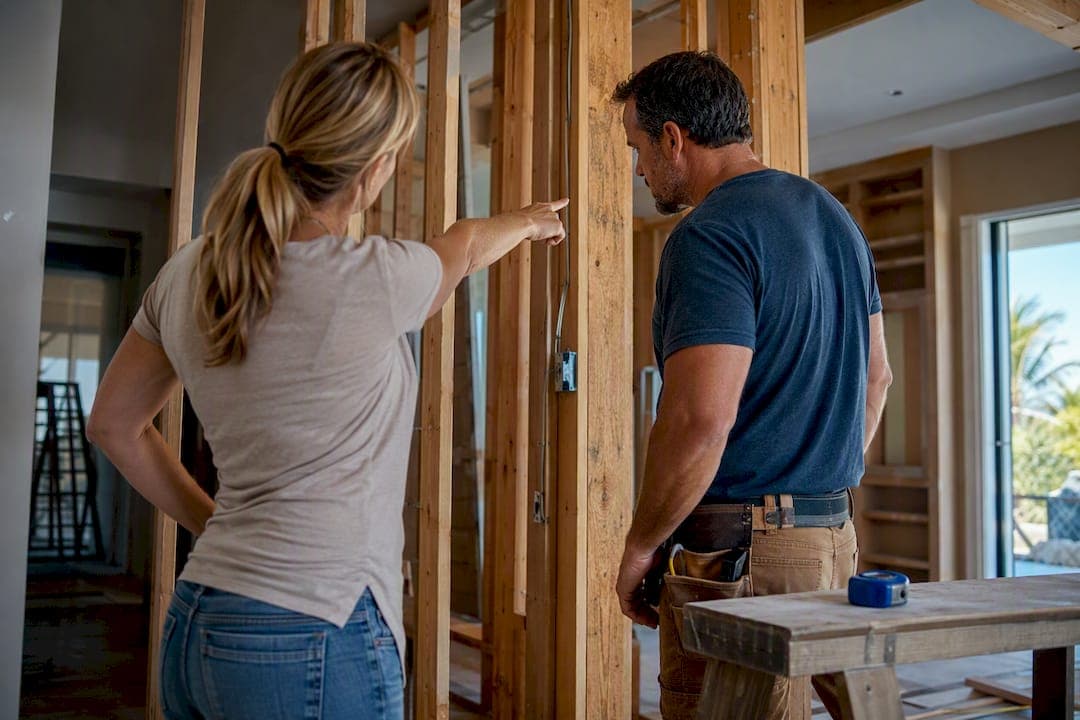
Before you hire anyone, ask for proof of license and insurance and a line-item written estimate that includes a signed change-order policy. If both check out, move to reference calls. This single sequence catches most of the problems that turn a renovation into a financial or legal headache, and everything else in this guide builds on it.
TL;DR:
- Verify the contractor's license number and insurance coverage independently through official sources before signing any agreements.
- Require a detailed line-item estimate and a written change-order policy to prevent scope creep and hidden costs.
- Tie payment milestones to verified project phases and ask how delays and rework are handled financially and legally.
- Confirm who is responsible for permits, inspections, and resolving code violations with signed documentation from the contractor.
- Contact recent references and visit current or completed sites to assess past project outcomes and gauge the contractor's reliability.
Table of Contents
- Quick Checklist: 10 Questions to Ask a Contractor on the First Call
- Credentials and Insurance: What to Ask and How to Verify It
- Scope, Estimates, and Change Orders: Get It in Writing
- Timeline and Schedule: Milestones and Delay Remedies
- Permits and Inspections: Who's Responsible
- Quality Control, Subcontractors, and Warranty Terms
- Communication, Site Protection, and Your Own Decision Deadlines
- References and Red Flags: Vetting Before You Sign
- Why the First Five Minutes Matter Most
- How Buildwithng Handles Estimates, Permits, and Warranty Support
- Sources Worth Bookmarking Before You Sign
- Sources
- FAQ
Quick Checklist: 10 Questions to Ask a Contractor on the First Call
A first conversation with a contractor should feel more like a screening interview than small talk. Here are the essential contractor interview questions to run through before you invite anyone to bid:
- What's your license number, and what business name is it registered under?
- Can you send proof of general liability and workers' comp insurance?
- When could you realistically start, and who supervises the crew day to day?
- Will I get a line-item estimate, not just a lump-sum number?
- What's the payment schedule, and how is it tied to progress?
- Who pulls the permits, you or me?
- What warranty do you offer on labor versus materials?
- Can you give me two or three references from similar recent projects?
- How do you handle change orders when something extra comes up?
- Do you require an upfront cash deposit, and if so, how much?
That last question matters more than it sounds. A contractor asking for 50% or more before work begins, or insisting on cash only, is one of the clearest early warning signs in this whole process.
Credentials and Insurance: What to Ask and How to Verify It
Getting a license number is only step one. Confirm it independently, and confirm the coverage behind it, before any money changes hands.
- Ask for the exact license number and the legal business name tied to it, since some contractors operate under a different name than the one on their license.
- Request a Certificate of Insurance (COI) showing general liability and workers' compensation, with policy limits and expiration dates visible.
- Look up the license directly through your state contractor licensing board rather than trusting a business card or website badge.
- Call the insurer listed on the COI to confirm the policy is active, not just present on paper.
Red flags here include expired policies, a business name that doesn't match the license, or no workers' comp coverage when subcontractors are on site. The Better Business Bureau's contractor hiring guidance recommends verifying credentials and reviewing past customer experience before signing anything, and that verification step alone eliminates a large share of bad hires.
Pro Tip: Ask the insurer, not the contractor, to confirm the policy status. A COI can be real but already canceled, and the contractor may not even know it.
Scope, Estimates, and Change Orders: Get It in Writing
A free estimate and a written quote are not the same document, and confusing the two is where a lot of homeowners get burned. A free estimate typically means a rough, no-obligation figure based on a quick walkthrough, while a detailed line-item quote reflects real measurements, material costs, and labor breakdowns. Some contractors charge for the more detailed version, and that fee can actually signal a more rigorous estimating process rather than a red flag.
Ask for these specifics before comparing any bids:
- A line-by-line scope of work covering labor, materials, permits, cleanup, and explicit exclusions.
- Clear dollar amounts assigned to every "allowance" item (fixtures, flooring, appliances) rather than vague placeholders.
- A written change-order policy that spells out how price and timeline shift once extra work is approved.
- Signatures required on any change order before that work starts, not after.
AIA Contracts guidance on construction allowances stresses tying every allowance to a specific number and documenting change orders formally, precisely because vague allowances are one of the most common sources of runaway budgets. A related breakdown of how scope gaps cause rework makes the same point from the finishing-trades side: unclear scope language costs money twice, once in the bid and again in the fix.
Timeline and Schedule: Milestones and Delay Remedies
Ask for a written project schedule with real milestones, a projected completion date, and a plan for reporting delays before they happen.
- Request a schedule broken into phases (demo, framing, rough-in, finish) with target dates for each.
- Ask what typically causes delays on projects like yours, weather, material lead times, permit backlogs, and how you'll be notified.
- Tie payment draws to verifiable milestones rather than calendar dates, so you're not paying for work that hasn't happened yet.
- Ask directly what remedy exists if the project runs significantly over schedule.
A contractor who can't answer the delay question specifically, or who waves it off with "it usually goes fine," hasn't managed enough real projects to give you a straight answer.
Permits and Inspections: Who's Responsible
Permit handling should never be left ambiguous. Ask who pulls each permit and who's present for inspections, then request copies of the actual approvals once they're issued.
- Confirm whether the contractor or you are the permit applicant of record, since that affects liability if something's built out of code.
- Ask how failed inspections get handled and who pays for the rework, the contractor or an added charge to you.
- For additions or structural work, ask how recently the contractor has dealt with your local code updates, since requirements shift and outdated assumptions cause denials.
Getting copies of inspection sign-offs at project close isn't optional paperwork. It's your proof the work is legally documented if you ever sell the home.
Quality Control, Subcontractors, and Warranty Terms
Craftsmanship quality often comes down to supervision, not just skill. Ask who checks subcontractor work daily and how often the lead contractor personally inspects progress, not just the office manager who signed the contract.
- Ask who supervises subcontractors on site each day, and how often the contractor personally reviews completed work.
- Request written warranty terms that separate material coverage from labor coverage, including how long each lasts and how to file a claim.
- Ask for final documentation: lien releases from every subcontractor, as-built drawings, appliance and equipment manuals, and a signed punch-list completion record.
NAHB's guidance for homebuyers recommends asking builders directly about warranty programs and what's included, since coverage gaps show up years later when they're hardest to fix. Asking what a contractor would do if you weren't happy with the finished work often reveals more about their conflict-resolution style than any technical question you could ask.
Pro Tip: Get lien releases from every subcontractor at final payment, not just the general contractor. Without them, a sub who wasn't paid can file a claim against your property even after you've settled the bill in full.
Communication, Site Protection, and Your Own Decision Deadlines
Set expectations early for who talks to you and how often. A daily on-site contact, a weekly check-in call, or a shared project portal all work, but you need to know which one you're getting.
- Ask who your primary daily contact is and how you'll receive updates.
- Ask how the crew protects floors, furniture, and adjacent rooms, and how they contain dust during demolition.
- Ask which decisions (tile selection, fixture finishes, paint colors) have hard deadlines, and how a late decision on your end affects the schedule or cost.
A Houzz breakdown of pre-start contractor questions flags jobsite protection and communication cadence as two of the most overlooked items homeowners forget to ask about, right up until the dust settles into the carpet.
References and Red Flags: Vetting Before You Sign
Ask for two or three recent clients with projects similar in scope to yours, and ask permission to walk through a current or recently finished job in person.
- When calling references, ask: Was the project finished on time and on budget? What problems came up, and how were they resolved? Would you hire this contractor again?
- Visiting a completed home in person often reveals more about post-project service than any photo portfolio, especially how warranty claims got handled after move-in.
- Watch for immediate red flags: demands for a large cash deposit, reluctance to put anything in writing, vague or evasive answers to direct questions, or an inability to produce recent references.
A longer reference list isn't just padding. Established resources for vetting home builders before signing consistently point back to the same combination: verified license, real site visits, and clients willing to talk candidly about what went wrong and how it got fixed.
Why the First Five Minutes Matter Most
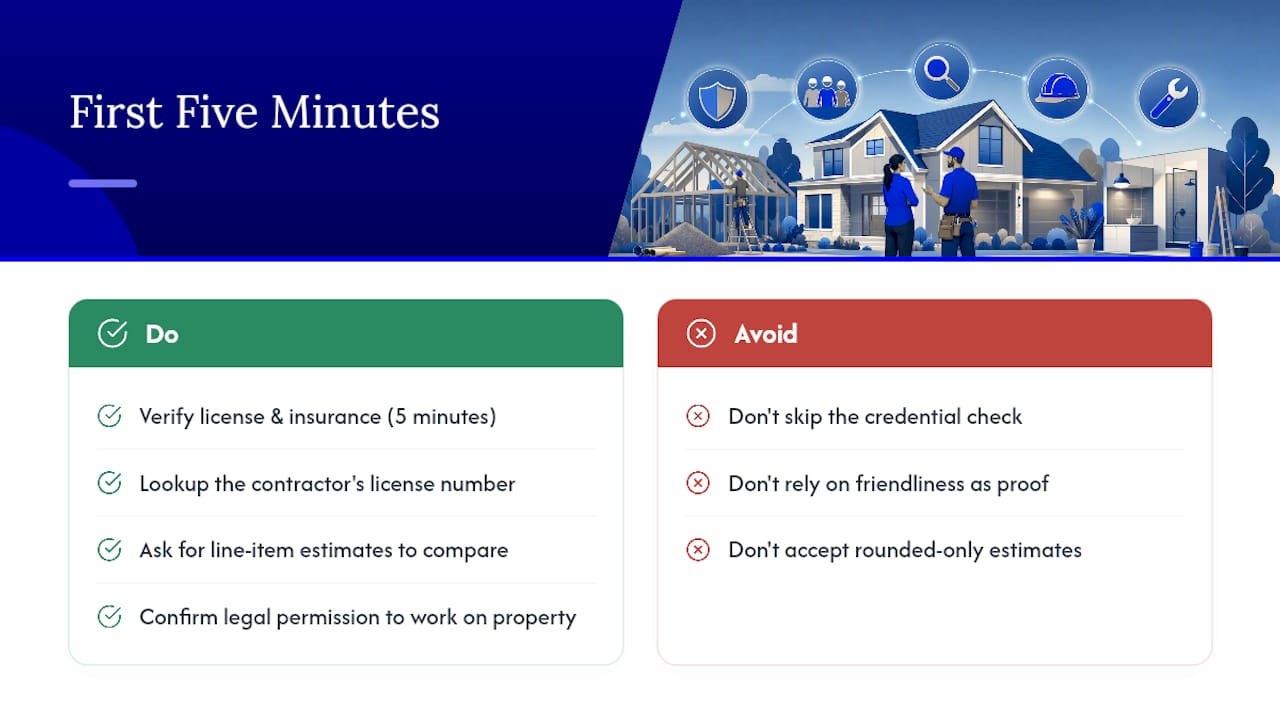
The order of these questions isn't arbitrary. License and insurance verification takes five minutes and eliminates most bad actors before you've invested any real time. Everything downstream, the estimate, the schedule, the warranty, only matters if the contractor is legally allowed to be on your property in the first place.
Some contractors provide estimates as line-item documents rather than rounded figures, because that's the only format that lets homeowners actually compare bids apples to apples. We've watched projects go sideways for one reason more than any other: a homeowner skipped the credential check because the contractor seemed friendly on the phone. Friendly doesn't verify a license number. A five-minute lookup does.
— Alston
How Buildwithng Handles Estimates, Permits, and Warranty Support
If you're building or renovating, some contractors offer a way to skip the guesswork entirely. Some contractors provide free, no-obligation estimates built as real line-item documents and manage projects through all phases from initial design through final inspection.

Some contractors will provide a sample scope of work, their Certificate of Insurance, and connect you with recent clients for reference calls, the same verification steps recommended here. Some contractors back projects with a workmanship guarantee, so warranty terms are provided upfront rather than after move-in. If you're ready to compare a real written estimate against whatever else you've collected, request your free estimate from Buildwithng and see the difference a line-item scope makes before you sign anything.
Sources Worth Bookmarking Before You Sign
- FTC cooling-off rule guidance explains when consumers can cancel certain sales contracts.
- AIA Contracts on construction allowances sets the standard for allowance and change-order documentation.
- BBB contractor hiring tips cover license and insurance verification steps.
Sources
Two to three recent clients with projects similar in scope to yours is standard, and you should also ask permission to walk through a current or finished job in person. A contractor who can't produce any recent references has given you a clear reason to keep looking.
- Construction allowance contracting basics | AIA Contracts
- Buyer's remorse: When the FTC's cooling-off rule may help | FTC
- Questions to ask your home builder | NAHB
- Hiring a contractor: tips | BBB
- Are estimates free? | FreshBooks
FAQ
What are the most important questions to ask a contractor before hiring?
Start with license number and proof of insurance, then move to a written line-item estimate, payment schedule, and how change orders are handled. Those four cover the money, legal, and schedule risks that cause most disputes.
What are red flags when hiring a contractor?
Demands for a large upfront cash deposit, refusal to put the scope in writing, vague answers about permits or insurance, and no recent references are the clearest warning signs. Any one of these on its own deserves a follow-up question before you proceed.
What should you not tell a contractor?
Avoid revealing your maximum budget upfront or signaling that you're desperate for a fast start, since either can shift the negotiation in the contractor's favor. Stick to asking specific, verifiable questions instead of volunteering information that weakens your position.
What's the difference between a free estimate and a quote?
A free estimate is typically a rough, no-obligation figure based on a quick assessment, while a detailed quote reflects a line-item breakdown of labor, materials, and costs after real measurements. Some contractors provide detailed written estimates at no cost, which gives you the accuracy of a quote without the fee some companies charge for it.