
Pick the financing that matches your equity and your project's scale. Homeowners with substantial equity usually do best with a home equity loan, HELOC, or cash-out refinance because these carry the lowest rates. If your equity is thin, renovation or construction loans that lend against after-renovation value can bridge the gap. Personal loans and credit cards work best as a backup for small or urgent costs, not as your primary plan.
TL;DR:
- Home equity loans, HELOCs, and cash-out refinances offer the lowest rates for homeowners with substantial equity, while renovation loans and construction loans suit those lacking enough current equity.
- HELOCs are ideal for phased projects with ongoing costs, but variable rates can increase payments mid-build, whereas home equity loans provide fixed payments upfront for lump-sum projects.
- Renovation and construction loans can base funding on a home's after-renovation value, making them suitable for homeowners with limited current equity but involve more paperwork and longer approval times.
- Personal loans and credit cards are best for small, urgent expenses, bearing higher interest and lower borrowing limits, and should be used as supplementary funds, not primary financing.
- A detailed contractor bid and a clear draw schedule are crucial to speed up approval, and homeowners should prioritize contractor documentation over just lender shopping to avoid delays.
Table of Contents
- Comparing Home Addition Financing Options at a Glance
- How Do HELOCs, Home Equity Loans, and Cash-Out Refinancing Work?
- What Renovation and Construction Loans Cover When Equity Falls Short
- When Do Personal Loans or Credit Cards Make Sense?
- How Do You Choose the Right Loan and What Should You Ask Lenders?
- What Documents and Timeline Should You Expect?
- How a Contractor Prepares You for Lender Approval
- The Financing Advice Most Homeowners Get Wrong
- Get a Lender-Ready Estimate for Your Addition
- Sources
Comparing Home Addition Financing Options at a Glance
Before you commit to a lender, it helps to see all your options side by side. Each one fits a different combination of equity, credit, and project size, and the right choice for your neighbor's kitchen bump-out might be the wrong one for your second-story addition.
- HELOC: Best for phased projects where costs trickle out over months. Drawback: variable rates mean your payment can climb mid-project.
- Home equity loan: Best for one lump payment to a general contractor with a fixed budget. Drawback: you start paying interest on the full amount immediately, even before construction begins.
- Cash-out refinance: Best when current mortgage rates are near or below what you already pay. Drawback: you reset your loan term and can lose a favorable existing rate.
- Renovation loans (FHA 203(k), HomeStyle): Best when your addition's cost exceeds your current equity. Drawback: more paperwork and a longer closing timeline.
- Construction loan: Best for large-scale additions built from stamped architectural plans. Drawback: short-term, often interest-only, and requires conversion to a permanent mortgage later.
- Personal loan or credit card: Best for small finish-out costs or timing gaps. Drawback: higher interest rates and lower borrowing limits.
Before applying anywhere, get an itemized bid from a licensed contractor and a prequalification from at least one lender. Both documents shape every decision that follows.
How Do HELOCs, Home Equity Loans, and Cash-Out Refinancing Work?
All three options borrow against the value you've already built in your home, and lenders calculate how much you can access using loan-to-value, or LTV. Most lenders let homeowners borrow up to roughly 80% to 90% of their home's value, minus what's still owed on the mortgage. That gap between your home's market value and your loan balance is your usable equity.
Here's how the math typically breaks down:
- Start with your home's current appraised value.
- Multiply that value by 80% (a common lender cap).
- Subtract your remaining mortgage balance from that number.
- The result is roughly what you can borrow through a HELOC or home equity loan.
Quick math: a house worth $500,000 with a $200,000 mortgage balance gives you about $400,000 in borrowing capacity at an 80% cap, minus the $200,000 owed. That leaves roughly $200,000 in usable equity, enough for most additions short of a full second story.
A HELOC works like a credit line: you draw funds as work progresses and pay interest only on what you've used, which suits a phased build better than a lump sum. A home equity loan hands you the full amount upfront at a fixed rate, which fits a contractor's fixed-price bid. A cash-out refinance replaces your entire mortgage with a larger one, and it only makes sense if today's rates are close to or better than what you're already paying. If you locked in a low rate years ago, refinancing to fund an addition can cost you more over time than a second loan would.
What Renovation and Construction Loans Cover When Equity Falls Short
When your current equity can't cover the project, lenders can size your loan against the home's after-renovation value, or ARV, instead of its current worth. An appraiser reviews your contractor's plans and estimates what the home will be worth once the addition is finished, and the loan amount gets calculated against that projected figure. That single mechanism is why ARV-based lending exists: it lets newer homeowners with little built-up equity still finance a six-figure addition.
FHA 203(k) loans are the government-backed version of this idea. They accept lower credit scores than many conventional programs and roll renovation costs directly into your mortgage, though the program requires a consultant and closer oversight on larger scopes. Fannie Mae's HomeStyle and Freddie Mac's CHOICERenovation loans work similarly but suit borrowers with stronger credit who want more flexibility on finish-level upgrades. A standalone construction loan, meanwhile, is a short-term product that converts into a permanent mortgage once the certificate of occupancy is issued.
All of these share the same operating mechanics: funds release in draws as work is completed and inspected, not as one check. Before approval, expect lenders to require:
- Stamped architectural drawings or engineering plans
- A licensed contractor's detailed bid
- Building permits already pulled or ready to pull
- Proof of contractor insurance and liability coverage
Pro Tip: Ask your contractor to submit the draw schedule alongside the bid, not after closing. Lenders release money against completed phases, and a mismatched schedule is the single most common cause of mid-project payment delays.
When Do Personal Loans or Credit Cards Make Sense?
For smaller jobs, unsecured financing avoids putting your house on the line, though you'll pay for that safety in higher interest and a lower ceiling on what you can borrow. These tools work best as a supplement, not a foundation.
- Personal loans: Fund within days, unsecured, generally practical for projects under roughly $50,000 depending on the lender.
- Credit cards: Fastest access to funds, but APRs routinely run well above secured loan rates, making them a poor fit for financing that stretches beyond a few months.
- Blended approach: Many homeowners use a HELOC to cover the bulk of construction costs and a card for last-minute fixtures or furniture, paying that balance off quickly to dodge interest.
If you're weighing a smaller refresh instead of a full addition, some homeowners find quick-turnaround remodel options solve the space problem without touching equity at all.
How Do You Choose the Right Loan and What Should You Ask Lenders?
Getting from "I want more space" to "I have signed financing" follows a predictable sequence, and skipping a step is where most delays start.
- Get an itemized bid from a licensed contractor so you know the real total cost, not a ballpark guess.
- Check your usable equity using the LTV math above.
- Get prequalified with at least two lenders to compare real offers, not advertised rates.
- Choose the loan type that matches your equity position and project timeline.
When you talk to lenders, ask directly: Is the rate fixed or variable? What's the full APR, including fees? What triggers a draw release? Is the appraisal based on current value or ARV? What's the total closing time?
When you talk to contractors, ask for an itemized bid broken out by line item, a written schedule tied to draw stages, and proof of insurance with lien waivers for each phase of work.
Pro Tip: Walk away from any lender who can't explain draw release conditions in plain terms, or any contractor who resists putting the payment schedule in writing. Both are red flags for disputes down the road.
What Documents and Timeline Should You Expect?
Lenders move faster when your paperwork is complete on the first submission. Expect to gather stamped plans, an itemized contractor bid, two years of tax returns, recent mortgage statements, and proof of your contractor's license and insurance.
Timelines vary sharply by product, and that gap catches a lot of homeowners off guard. Personal loans can fund within days. HELOCs and home equity loans typically close in one to three weeks. Cash-out refinances usually take 30 to 45 days, and renovation or FHA 203(k) loans often run 45 days or longer because of the added appraisal and consultant review steps.
Budget beyond the construction bid itself. Permits, design or engineering fees, and a contingency buffer belong in your total financing request, not as an afterthought you scramble to cover later.
| Addition Type | Typical Cost Range |
|---|---|
| Small bump-out (e.g., bay window, mudroom) | costs can start from a few thousand dollars up to tens of thousands |
| Mid-size room addition | often runs into the lower hundreds of thousands depending on scope |
| Full second story | can be a major investment reaching several hundred thousand dollars |
How a Contractor Prepares You for Lender Approval
A design-build firm like NG Construction SWFL hands you stamped plans and a detailed itemized bid from the start, the exact documentation lenders ask for before approving renovation and construction financing. Managing draw schedules and final inspections in-house keeps your loan on track instead of stalled on paperwork. A workmanship guarantee and single-point project management also cut down on the change orders that make lenders nervous mid-build.

The Financing Advice Most Homeowners Get Wrong
Most guidance on this topic treats loan selection like a checklist: fill in your credit score, pick a product, done. That misses the real driver, which is timing mismatch between how your money arrives and how your contractor spends it. A homeowner with plenty of equity who takes a lump-sum home equity loan for a phased addition ends up paying interest on money sitting idle in an account for months. That's not a rate problem. It's a structure problem, and no amount of shopping for a lower APR fixes it.
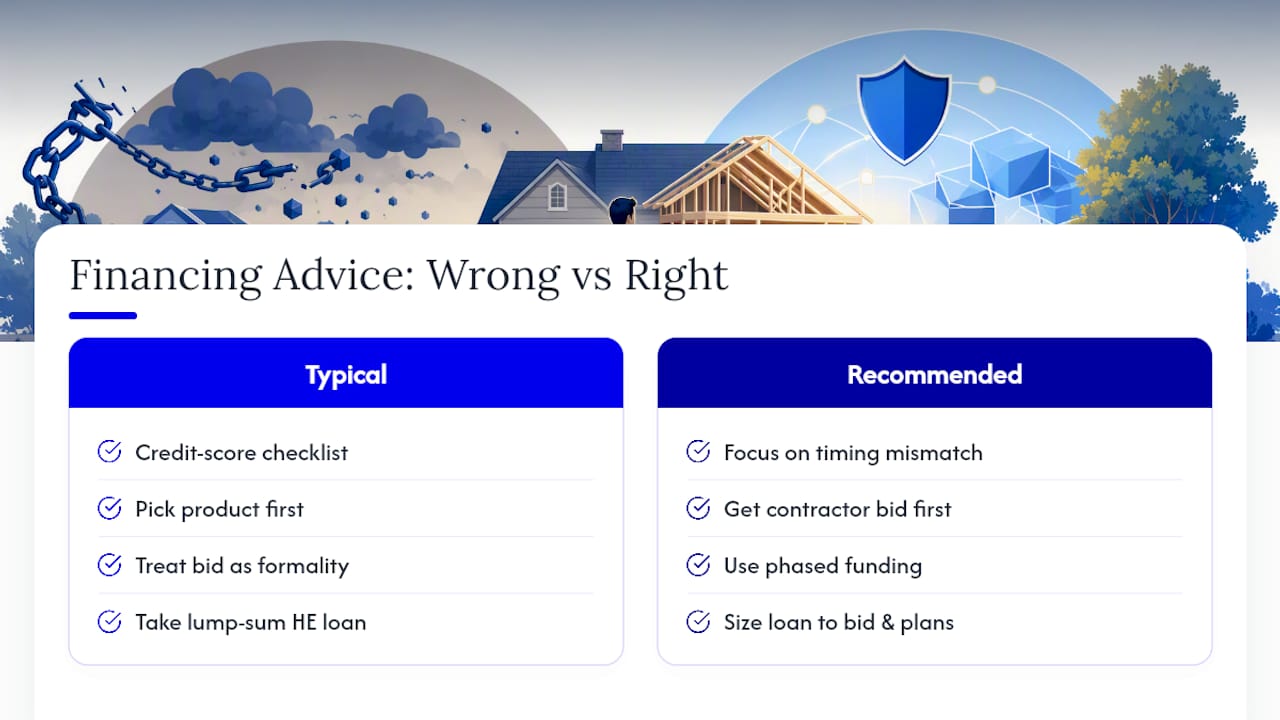
The bigger blind spot is treating the contractor's bid as a formality you get after choosing a loan. In practice, the bid should come first. Lenders size ARV-based loans off the plans and the bid, not off your hopes for the finished square footage. Homeowners who walk into a lender's office with a vague number and no stamped drawings routinely get slower approvals and lower loan offers than the project actually supports.
If there's one thing worth doing differently, it's this: treat your contractor's documentation as part of your financing strategy, not a separate track. A precise, itemized bid does more to speed up approval than switching lenders ever will.
— Alston
Get a Lender-Ready Estimate for Your Addition
The financing side only works if the construction side backs it up with real numbers, not guesses. Buildwithng gives Southwest Florida homeowners a free, no-obligation estimate with the itemized bid detail your lender will actually ask for, so you're not stuck reworking paperwork mid-application.

NG Construction SWFL manages the design-to-build process from stamped plans through final inspection, including the draw schedules that renovation and construction loans depend on. Every project carries a workmanship guarantee, and because one team handles design, permitting, and build, you avoid the change orders that make lenders hesitate. If you're in Cape Coral, Fort Myers, Naples, Bonita Springs, or Estero and ready to move on an addition, request your free estimate from NG Construction SWFL and get a contractor-ready bid in hand before you walk into a lender's office.
Sources
- Eight ways to finance your home renovation project — Opendoor
- It’s smart to plan how to finance a home remodel — Angi
- How to finance a home addition — U.S. Bank
- How to finance the cost of a home addition — Bankrate