A construction draw schedule is the plan that releases loan funds in staged disbursements tied to verified construction milestones, typically 4 to 8 draws over the build. Lenders use it to limit exposure and confirm work is real before money moves. For borrowers and contractors, it's also the single document that determines whether cash flow matches the pace of work or falls behind it. Every draw runs through the same loop: request, inspection, approval, funding.
TL;DR:
- Most residential construction loans involve four to eight draws, with funding typically occurring within 5 to 10 business days after inspector approval.
- The interest reserve during construction only covers accruing interest and is not additional spending money for the borrower.
- Proper documentation, including lien waivers, detailed invoices, and photos, is crucial for avoiding delays or denials during the draw request process.
- Clear, verifiable milestones like passing inspections and signed documentation prevent disputes over draw triggers and keep payment schedules on track.
- Coordinating the draw schedule closely with subcontractor payment cycles and proactively managing documentation ensures smoother cash flow and reduces project delays.
Table of Contents
- Draw Schedule Numbers Every Borrower Should Know
- Draw Schedule vs. Payment Schedule vs. Invoice
- How the Draw Request Process Actually Works
- A Sample 6-Draw Schedule You Can Adapt
- Milestones That Make Good Draw Triggers
- Building a Schedule of Values That Actually Works
- Retainage and Interest Reserve: The Cash-Flow Squeeze
- A Step-by-Step Checklist Before You Sign
- Keeping Draws From Freezing Mid-Project
- Turning the Draw Schedule Into a Cash-Flow Plan
- What Most Draw Schedule Disputes Actually Come Down To
- How Buildwithng Keeps Your Draw Schedule Moving
- Sources
- FAQ
Draw Schedule Numbers Every Borrower Should Know
Most residential construction loans use between four and eight draws, though monthly progress billing is common on larger or commercial jobs. Once a draw request clears inspection, lenders typically fund within 5 to 10 business days, depending on the lender's internal review process and how quickly the inspector's report gets filed.
Quick reference numbers:
- Typical draw count: 4 to 8 for residential builds
- Inspection-to-funding lag: 2 to 10 business days
- Standard retainage: 5% to 10%, held until substantial completion
- Interest reserve: covers interest-only payments on the drawn balance during construction
A number that surprises first-time borrowers: the interest reserve isn't extra money you get to spend. Construction loans are typically interest-only during the build, and the reserve exists specifically to cover that accruing interest so you're not writing a check every month on top of paying subcontractors.
Draw Schedule vs. Payment Schedule vs. Invoice
These three terms get used interchangeably on job sites, and that confusion causes real delays. A construction draw schedule is the lender-facing document that governs when loan funds release. A progress payment schedule is often the same structure viewed from the contractor's side, tied to the construction contract rather than the loan. An invoice is the individual bill submitted for one draw period, referencing specific completed work.
Here's how they relate in practice:
- The draw schedule sets the overall framework: how many draws, what triggers each one, and roughly when they'll happen
- The payment schedule in the construction contract should mirror the loan's draw schedule so the contractor isn't waiting on the owner while the owner waits on the bank
- Each invoice within a draw period ties back to specific Schedule of Values line items
- The schedule gets negotiated and attached as a contract exhibit before signing, and again as part of the loan closing package
Lenders require a formal draw schedule because it's their primary tool for verifying that loan proceeds actually convert into finished construction rather than sitting idle or getting diverted. Without it, a construction loan is just an unsecured bet on a promise.
How the Draw Request Process Actually Works
The mechanics behind each draw follow a fairly consistent sequence, whether you're dealing with a regional bank or a private construction lender.
- Submit the draw request. This package maps completed work to specific Schedule of Values line items, includes subcontractor and supplier invoices, and attaches conditional lien waivers along with dated progress photos.
- Inspection and verification. A lender-assigned inspector or the lender's own representative visits the site, confirms the percentage of completion against the SOV, and files a report. This is where poorly documented requests stall.
- Underwriter review and approval. The lender cross-checks the inspector's findings against the request, flags discrepancies, and either approves the full amount, approves a partial amount, or holds the draw pending clarification.
- Funding. Once approved, funds typically hit the account within 5 to 10 business days, though this window shrinks with electronic submission and lenders familiar with the borrower's project.
Partial approvals and holdbacks usually trace back to one of three causes: missing lien waivers, an inspector's percent-complete estimate that's lower than the request, or SOV line items that don't clearly match the invoiced work. Each one is preventable with tighter paperwork upfront.
A Sample 6-Draw Schedule You Can Adapt
Here's a workable structure for a mid-size residential build, using percentages of total contract value. Percentage splits like these are widely used as starting templates, and every contractor should adjust them to match their own trade sequencing and lead times.
| Draw | Trigger | % of contract | Typical timing |
|---|---|---|---|
| 1 | Signed contract, permits pulled | around 10% | Early in the project |
| 2 | Foundation poured and inspected | mid-phase percentage | Early to mid phase |
| 3 | Framing and dry-in complete | mid-phase percentage | Mid phase |
| 4 | Mechanical, electrical, plumbing rough-in passed | mid-phase percentage | Mid to late phase |
| 5 | Exterior finish and drywall complete | mid-phase percentage | Late phase |
| 6 | Substantial completion, certificate of occupancy | around 15% | At project completion |
Adjust this if your project carries expensive long-lead items, like custom windows or imported fixtures. A material-heavy trade often needs a supplemental draw tied to material delivery and deposit rather than waiting for installation, otherwise the contractor fronts thousands in materials with no reimbursement until months later.
Attach the SOV as a companion exhibit, and spell out payment terms explicitly: days-to-pay after approval (net 10 or net 15 is standard), and the retainage percentage held back from each draw until final release.
Milestones That Make Good Draw Triggers
Vague milestones cause disputes. "Framing substantially done" invites disagreement; "framing inspection passed with signed card on file" doesn't. The strongest draw triggers are ones any inspector could verify without a judgment call.
- Foundation: Concrete poured, cured, and passed municipal inspection with a signed inspection card
- Framing and dry-in: Structural frame complete, roof sheathed, and building wrapped or dried in against weather
- Mechanical rough-in: Plumbing, electrical, and HVAC rough-in installed and passed rough inspection tests
- Exterior finish: Siding, roofing, windows, and doors installed and weather-sealed
- Interior finish: Drywall, paint, flooring, cabinetry, and fixtures substantially complete
- Substantial completion: Certificate of occupancy issued, punch list generated, final lien waivers collected
Trade-specific triggers work best when tied to a document, not a description. Roofing gets tied to a manufacturer's final inspection sign-off. Rough electrical gets tied to the passed inspection card, not "wiring mostly in." That specificity is what keeps a draw from getting flagged during lender review.
Building a Schedule of Values That Actually Works
The Schedule of Values is the foundation everything else rests on. It breaks the total contract price into individual line items, each with a dollar value and a running cumulative percentage, so a lender or inspector can verify exactly what's been completed against what's been billed.
Essential fields for every SOV line item:
- Line item description (specific enough to inspect, like "rough electrical, first floor")
- Scheduled value in dollars
- Percentage of total contract this line represents
- Cumulative percent complete to date
- Amount previously billed vs. amount requested this draw
Group related SOV lines into each milestone draw rather than billing every trade separately. Foundation work, for instance, might combine excavation, footings, and slab into one draw trigger even though they're three separate SOV lines.
Pro Tip: Keep your SOV granular enough that a single disputed line item doesn't hold up an entire draw. If "kitchen cabinets" and "kitchen countertops" are one combined line and the countertops are backordered, you've just delayed payment for finished cabinet work too.
Maintain a running percent-complete register updated with each draw. Line-item affidavits speed lender approvals considerably because the underwriter isn't reconstructing project status from scratch every time.
Retainage and Interest Reserve: The Cash-Flow Squeeze
Retainage is the portion of each draw a lender or owner withholds until later in the project, standard practice on most construction financing. Rates typically run 5% to 10%, released at substantial completion or after a specific trigger like the final inspection and unconditional lien waivers.
The interest reserve is a separate pool of loan funds set aside specifically to cover interest payments during construction, since most construction loans are interest-only until conversion to permanent financing. Sizing this reserve too small is one of the more common borrower mistakes, forcing an unplanned equity injection mid-build when the reserve runs dry before the project reaches completion.
Numbers to model into your draw math:
- Retainage held per draw: 5% to 10% of that draw's value
- Retainage release: typically at substantial completion, sometimes stepped down after 50% completion on larger jobs
- Interest reserve: calculated against expected draw pace and the loan's interest rate, not a flat estimate
Build both into your cash-flow projection from day one. A contractor expecting the full draw amount and getting 90% of it after retainage is a contractor who's suddenly short on payroll.
A Step-by-Step Checklist Before You Sign
Getting the draw schedule right before signing saves weeks of friction later.
- Confirm total scope and contract amount. Lock the final number before building the SOV around it.
- Build the Schedule of Values. Break the contract into line items granular enough to inspect but not so granular they create billing chaos.
- Group SOV lines into milestone draws. Assign percentages or dollar amounts to each of your 4 to 8 draws.
- Define verification evidence per draw. Specify exactly what counts: invoices, lien waivers, photos, signed inspection cards.
- Set days-to-pay terms. Net 10 or net 15 after approval is standard; write it into the contract, not just assumed.
- Calculate retainage and interest reserve impact. Model the net amount you'll actually receive at each draw, not the gross milestone value.
- Attach the schedule as a contract exhibit. Get lender sign-off on the exact same version the contractor is working from.
Pro Tip: Send your draw schedule and SOV to the lender's underwriting desk before the loan closes, not after. Catching a mismatch between your milestone triggers and their inspection criteria at closing is far cheaper than catching it at draw three.
Keeping Draws From Freezing Mid-Project
Frozen draws almost always trace back to documentation gaps rather than actual construction problems. A complete draw package includes current invoices matched to SOV lines, conditional lien waivers from every paid sub, dated photos of completed work, and signed inspection cards where applicable.
- Keep a running folder of lien waivers so you're never scrambling to collect three months of them at once
- Coordinate inspection timing with your inspector's schedule rather than assuming same-week availability. A resource like Lägeskontroll för byggherrar outlines the kind of positional and completion documentation inspectors expect before sign-off
- Photograph work before it gets covered, since drywall and siding hide the rough-in work a lender needs to verify
If a draw gets reduced or denied, respond immediately rather than waiting for the next cycle. Identify whether it's a documentation gap you can cure same-week, a legitimate scope dispute requiring a change order, or a genuine shortfall that needs an equity bridge from the owner to keep subcontractors paid on schedule.
Turning the Draw Schedule Into a Cash-Flow Plan
The draw schedule only protects your cash flow if you map it against a real timeline of outflows, not just inflows. Lay your six or eight draws against the calendar, then overlay every major payment obligation: subcontractor payroll cycles, material deposits, and supplier invoices due before the next draw lands.
The gap to watch for is the lag between when you owe a sub and when the corresponding draw actually funds. If framing payroll is due on the 15th but your draw doesn't fund until the 22nd, you need either a larger interest reserve buffer or a short-term bridge, worked out before it becomes urgent.
Common contingencies worth negotiating into the contract upfront:
- A stepped-down retainage release after 50% completion, freeing cash earlier on longer projects
- An owner equity injection clause for change orders that fall outside the original SOV
- A documented process for requesting an out-of-cycle partial draw when a long-lead material deposit falls between scheduled milestones
Run this projection before you sign anything, not after ground breaks.
What Most Draw Schedule Disputes Actually Come Down To
Most disputes over draw schedules aren't fights about money. They're fights about ambiguity that got baked into the contract before anyone realized it would matter. A milestone written as "rough-in substantially complete" sounds reasonable at signing and becomes a three-week argument the moment an inspector and a contractor disagree on what "substantially" means.
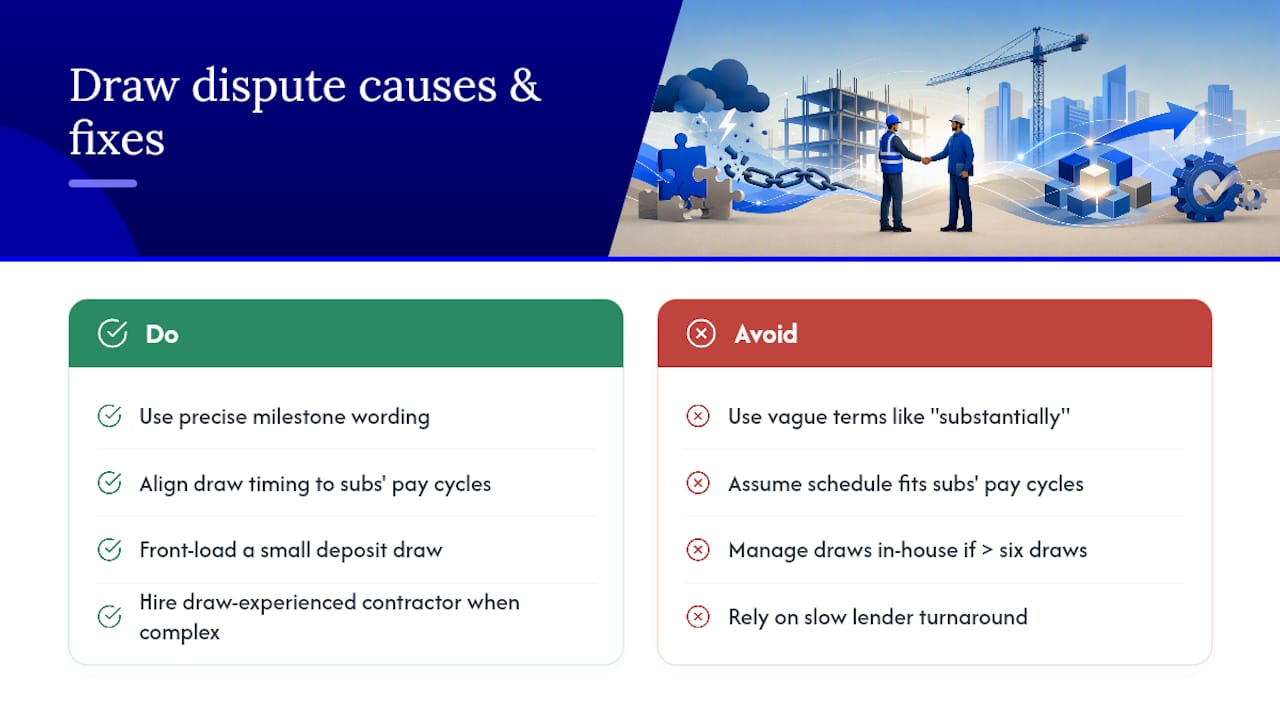
The practitioner lesson that gets overlooked most often: align your draw timing with your subcontractors' actual pay cycles, not just construction phases. If framing crews expect payment every two weeks and your draw only funds monthly, you're personally financing labor costs during that gap whether you planned to or not. The contractors who avoid this front-load a small deposit draw specifically to bridge that first cycle, rather than assuming the schedule will cover it.
Handling draws in-house works fine for owners comfortable with paperwork and inspection coordination. It stops working the moment a project has more than six or seven draws, multiple trades on tight sequencing, or a lender that's slow on turnaround. That's usually the point where hiring a contractor experienced in managing the draw process, not just the construction itself, pays for itself in avoided delays.
— Alston
How Buildwithng Keeps Your Draw Schedule Moving
A single accountable team handling the SOV, the documentation, and the inspection coordination can help keep disputes from ever starting. Rather than juggling separate conversations with your lender, your inspector, and your contractor, a single team managing design through final inspection can provide streamlined service.

That matters most at exactly the moments described above, where a missing lien waiver or a vague milestone trigger stalls a draw for weeks. A project management approach that builds the Schedule of Values and draw structure into the contract from day one can help lender review and inspection sign-off move faster because the paperwork matches what the lender expects. For custom home builds, renovations, room additions, and commercial build-outs, a coordinated approach can mean fewer frozen draws and a project that stays on the timeline you budgeted for.
If you're preparing a loan package or renegotiating a payment schedule with your contractor, request a free, no-obligation estimate from Buildwithng and get a draw structure built to hold up under lender review.
Sources
- Draw Schedules: Streamlining Construction Finance | Procore
- How does a construction loan draw schedule actually work? | Passy Capital
- Construction Payment Schedule Template: Protect Cash Flow on Every Job | Tasktag
- 2026 guide to construction retainage | Archdesk
- Free Contractor Payment Schedule (2026) | EstimationPro AI
FAQ
What Is a Draw Schedule in Construction?
A draw schedule is the plan governing when loan funds release to a borrower or contractor, tied to specific verified construction milestones rather than a flat monthly payment. Most residential projects use 4 to 8 draws, each triggered by an inspected and documented stage of completion.
What Is the Monthly Payment on a $300,000 Construction Loan?
During the construction phase, most loans are interest-only, so the payment is calculated against the drawn balance using the loan's stated interest rate. Because the balance grows with each draw, the payment increases over the build rather than staying fixed, and many borrowers rely on an interest reserve to cover this cost rather than paying out of pocket.
What Is a Standard Construction Schedule?
A standard construction schedule sequences the project's phases, typically starting with site prep and foundation, moving through framing and rough-ins, then exterior and interior finishes, ending at substantial completion. The draw schedule usually mirrors this same sequence, with each construction phase corresponding to a specific draw trigger.
What Are the 7 Phases of a Construction Project?
Definitions vary slightly by industry source, but a common version includes: pre-construction and planning, design, permitting, foundation, framing and rough-in, interior and exterior finishes, and final inspection or closeout. Draw schedules typically compress these into 4 to 8 payment milestones rather than tracking all seven phases as separate draws.
Who Prepares the Draw Schedule?
The contractor typically drafts the initial draw schedule and Schedule of Values, but it gets negotiated with the borrower and must satisfy the lender's requirements before loan closing. A firm managing the full design-build process, like Buildwithng, often builds the SOV and draw structure directly into the project plan so it's ready for lender review from the start.