
A change order is a written amendment that changes a construction contract's scope, price, or schedule, and it only takes effect once signed by both parties. The moment a change surfaces on site, the right move is simple: stop, document what happened, price the impact, and get a signed change order before any non-urgent work continues. Skip that step, and you risk two things: unauthorized work you can't get paid for, and missed notice deadlines that void your right to claim it at all.
TL;DR:
- Signatures from owner, contractor, and architect are mandatory for a change order to be legally binding; proposals or directives do not suffice.
- Proper documentation, prompt notice within the contract's specified window, and detailed, supported change orders are critical to prevent disputes and ensure payment.
- Pricing methods should match the scope clarity: lump sum for fully defined work, time and materials for uncertain scope, and not-to-exceed caps for balanced flexibility.
- Handling urgent work through construction change directives can keep projects moving when signatures are delayed but should be followed by proper signed change orders later.
- Delays in processing change orders hurt project timelines and cash flow for both contractors and owners, emphasizing the need for quick notice and fast pricing turnaround.
Table of Contents
- What Is a Change Order in Construction, and How Does It Differ From a COR or CCD?
- What Are the Most Common Types of Change Orders?
- How Does the Change Order Process Actually Work Step by Step?
- What Must Every Change Order Include?
- How Do You Price a Change Order Fairly?
- How Do You Avoid Change Order Disputes Through Better Documentation?
- How Does NG Construction SWFL Manage Change Orders on Real Projects?
- Why Do Delayed Change Orders Hurt Everyone, Not Just the Contractor?
- Get a Free Estimate That Accounts for Change Orders Before They Happen
- Where to Go Deeper on Change Order Contracts and Procedure
- Sources
What Is a Change Order in Construction, and How Does It Differ From a COR or CCD?
A signed change order is a binding contract modification. Under AIA standard contracts, it's a written instrument that the owner, contractor, and architect all sign to change the work, the contract sum, or the contract time. Until all three signatures exist, you don't have a change order. You have a proposal.
That distinction matters because several related terms get used interchangeably on job sites, and mixing them up creates real financial exposure:
- Change order request (COR): the contractor's proposed pricing and scope for a change, submitted for owner review. It carries no legal weight until accepted.
- Construction change directive (CCD): a unilateral instruction from the owner or architect to proceed with work before price or time is agreed, typically used when a delay would harm the project.
- Addendum: a modification made before contract signing, during the bidding phase. Once the contract is executed, changes go through change orders, not addenda.
A change order generally falls into one of three buckets: additions to scope, omissions from scope, or substitutions and alterations to what was already agreed. Knowing which bucket you're in shapes how you price it.
What Are the Most Common Types of Change Orders?
Not every change carries the same entitlement or risk. Sorting a change into the right category early tells you how strong your position is and what evidence you'll need.
- Owner-initiated changes. The homeowner wants upgraded countertops, an extra outlet, or a bumped-out closet. Entitlement is clear because the owner asked for it, and pricing usually moves fast since there's no dispute over cause.
- Design changes and coordination revisions. An architect updates a detail, or a mechanical drawing conflicts with structural framing. These often ripple into procurement, since materials already ordered may need to change too.
- Unforeseen site conditions. Rot behind a wall, undocumented utility lines, soil that won't support the planned footing. These require strong evidence, photos, inspection reports, and prompt notice, because the burden falls on the contractor to prove the condition wasn't reasonably foreseeable.
- Constructive changes. No one issued a formal directive, but the owner's actions or instructions effectively forced extra work anyway. These are the riskiest type because there's no paper trail unless you create one immediately, in writing, the day it happens.
How Does the Change Order Process Actually Work Step by Step?
The process runs in a predictable sequence, and skipping steps is where most disputes start.
- Identify the change and give notice immediately. Whoever spots the deviation, a superintendent, project manager, or the owner, needs to flag it in writing the same day. Verbal agreements on-site are the single most common source of unpaid change-order disputes.
- Prepare the change order request. Build the COR with a clear scope description, supporting documentation (photos, RFIs, supplier quotes), and a full cost breakdown. Vague CORs get rejected or renegotiated, which burns time you don't have.
- Review and negotiate. The owner or architect reviews the COR, usually within a contractually defined response window. Most back-and-forth happens over markup percentages and schedule impact, not the base scope.
- Execute and update records. Once both sides agree, the change order gets signed, and the project budget, schedule, and change order log all get updated the same day. An unrecorded verbal "yes" from an owner is not a signed change order.
- Use a CCD when time won't wait. If waiting for signatures would delay urgent work, such as a structural safety issue, issue a construction change directive instead. It lets work continue while preserving the contractor's right to negotiate final price and time later.
Pro Tip: Never let the phrase "we'll figure out the price later" substitute for a signed document. Even a one-page interim change order with a not-to-exceed cap protects both sides better than a handshake.
What Must Every Change Order Include?
A change order is only as strong as its wording. Ambiguity in any of these fields is what turns a routine adjustment into a legal argument three months later.
- Scope description specific enough that a third party could read it and know exactly what changed.
- Reference to the original contract section being modified.
- Full cost breakdown, not a lump figure with no support.
- A clear time statement: does this change grant an agreed schedule extension, or does it reserve the contractor's right to claim time later without committing to a number yet? Those are very different legal positions, and the wording should say which one applies.
- Signatures and dates from every party with contractual authority, matching the AIA requirement that a change order isn't valid until owner, contractor, and architect all sign.
Attach everything that backs up entitlement: date-stamped photos, the RFI that triggered the change, supplier quotes, and daily labor logs if field time is part of the cost. A step-by-step field guide for contractors reinforces a point worth repeating: proceeding on an unsigned COR risks nonpayment even when the work itself was clearly necessary.
How Do You Price a Change Order Fairly?
Three pricing methods dominate change-order work, and picking the right one depends on how well-defined the scope is.
- Lump sum works when scope is fully known upfront, like a specific tile upgrade with a fixed material and labor cost.
- Time and materials (T&M) fits when scope is uncertain at the start, such as opening a wall to investigate a leak. You bill actual hours and materials as the work unfolds.
- Not-to-exceed (NTE) caps a T&M arrangement at a ceiling price, giving the owner budget certainty while letting the contractor bill actual costs up to that limit.
Whichever method you choose, the estimate needs to capture the full commercial picture: direct labor, materials, equipment, subcontractor quotes, an allocated share of overhead, and markup. Markup ranges vary by region and contract type, but public contracts often cap them explicitly, which is worth checking before you price anything on a government job.
Autodesk's industry data suggests a substantial share of construction projects experience at least one major change during the build, which is exactly why a repeatable pricing method matters more than treating each change as a one-off negotiation.
Don't forget time-related costs. If a change delays the critical path, price the prolongation separately from the scope cost, and if the owner wants the schedule held anyway, acceleration costs (overtime, extra crews) belong in the same conversation, not a future dispute.
How Do You Avoid Change Order Disputes Through Better Documentation?
Most change-order disputes trace back to one of two failures: missed notice deadlines or thin documentation. Both are preventable.
- Know your notice window. Many contracts require written notice of a changed condition within a set number of days, often 5 to 14. Miss it, and you can lose the right to claim the cost even if the work was clearly justified.
- Keep a documentation trail: date-stamped photos, RFIs linked to the specific change, daily field logs, and a running change order log that tracks status from request to signature.
- Escalate properly when needed. If an owner won't sign but wants work to continue, use a CCD rather than proceeding on a verbal promise, and preserve your right to value the work later.
- Prove entitlement, causation, and quantum. AACE International's recommended practice frames this as the standard for any claim: show you had a contractual right to the change, connect the triggering event to the impact, and support the dollar amount with real numbers.
Pro Tip: Log the "why" behind every change order the day it happens, not weeks later. A photo with a timestamp and a one-line note referencing the RFI number is worth more in a dispute than a detailed memory.
The Associated General Contractors of America has flagged delayed change-order processing as a direct cause of cash-flow strain, particularly for smaller subcontractors who can't absorb weeks of unbilled work. Negotiating partial or interim payment on large changes keeps the job moving without forcing anyone to eat the cost of the owner's decision-making timeline.
How Does NG Construction SWFL Manage Change Orders on Real Projects?
Buildwithng runs every change order through the same accountability-first process regardless of project size, because ambiguity is what erodes trust between owners and contractors. The firm's approach centers on catching changes early, pricing them transparently, and never proceeding on unsigned work unless a documented directive protects both sides.
The internal checklist looks like this:
- Field team flags the change and photographs the condition the same day it's discovered.
- Project manager drafts the COR with a full cost breakdown within 48 hours.
- Client reviews and signs before non-urgent work resumes, with every version logged.
- Budget and schedule get updated the moment a change order is executed, not at the next billing cycle.
That structure exists because a signed change order is the only document that actually protects a homeowner's budget and a contractor's margin at the same time. Free estimates before the contract is signed catch scope questions before they become field disputes later.
Why Do Delayed Change Orders Hurt Everyone, Not Just the Contractor?
The conventional advice on change orders treats them as a contractor problem: get your paperwork right, protect your margin, don't do free work. That framing misses half the picture. Owners lose just as much when change orders drag, because delayed decisions stack up into delayed completion dates, and every week of schedule slip on a custom build compounds into carrying costs nobody budgeted for.
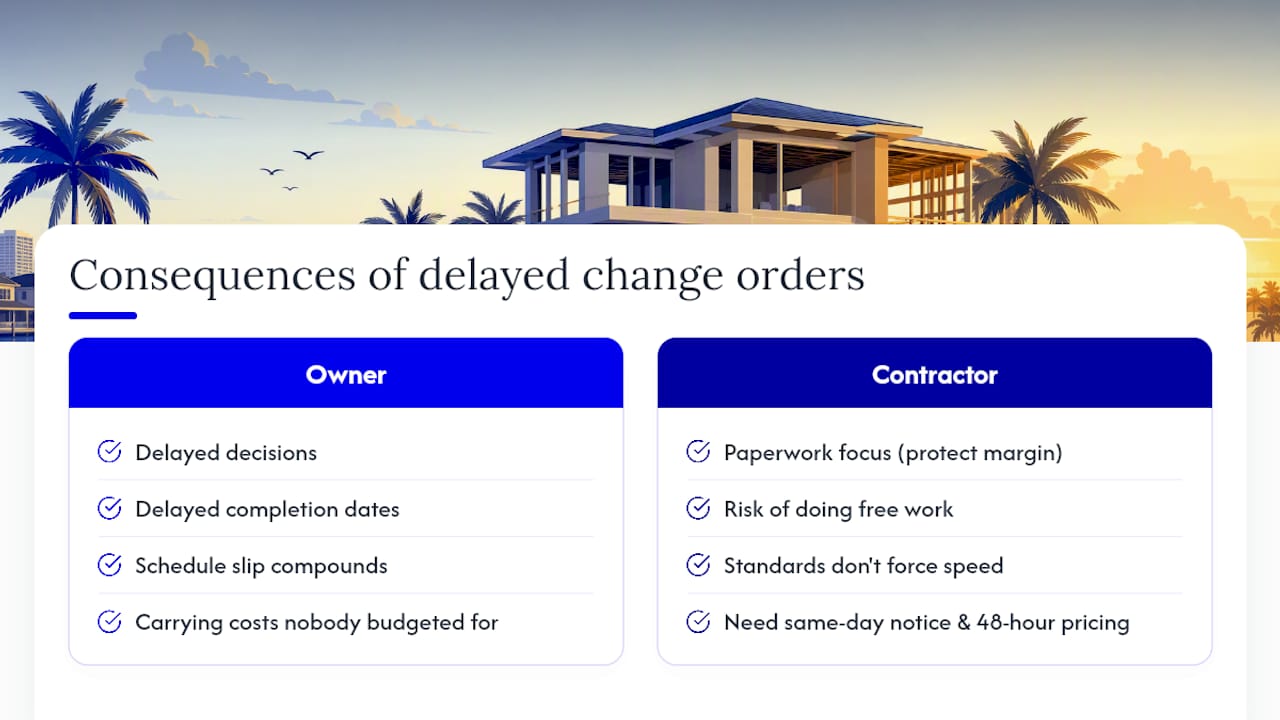
Where standards like AIA's contract language and AACE's entitlement framework fall short in practice is speed. They tell you what a valid change order must contain, but they don't force anyone to sign fast. That's a process problem, not a paperwork problem, and it's solved by whoever manages the job insisting on same-day notice and 48 hour pricing turnaround, not by better contract clauses.
If you take one thing from this, prioritize the notice deadline over everything else. A perfectly priced change order that missed its notice window is worthless. A rough estimate submitted on time preserves your position and lets you refine the number later.
— Alston
Get a Free Estimate That Accounts for Change Orders Before They Happen
Most change-order pain isn't really about pricing. It's about not having one accountable team managing scope, cost, and schedule from day one. Buildwithng builds that accountability into every custom home, renovation, and commercial project it takes on across Cape Coral, Fort Myers, Naples, Bonita Springs, and Estero, so changes get documented and priced fast instead of stalling your build for weeks.

That means fewer surprise costs, faster turnaround on any scope adjustment, and a paper trail that protects your budget from the first estimate through final inspection. Every project starts with a free, no-obligation estimate, so you know what you're working with before a shovel hits the ground. If you're planning a custom build or major renovation in Southwest Florida, request your free estimate and see how a team that manages change orders correctly keeps your project on schedule and on budget.
Where to Go Deeper on Change Order Contracts and Procedure
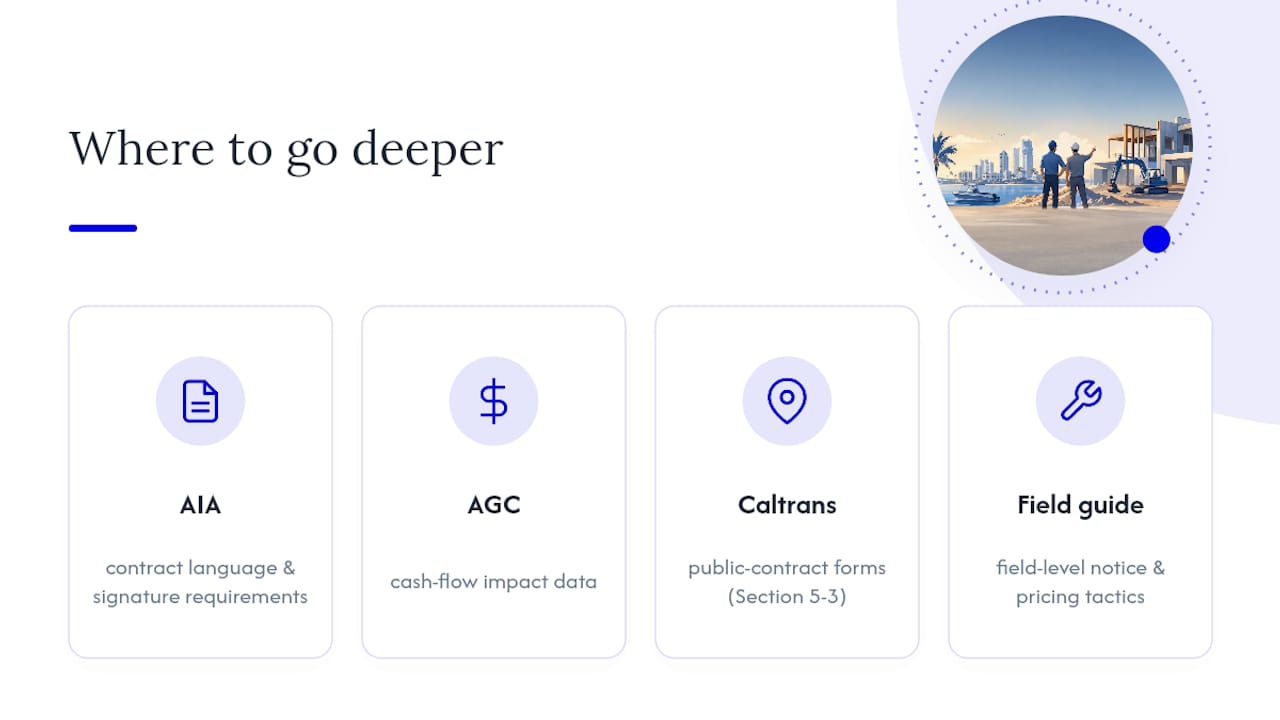
For contract language and signature requirements, see AIA's change order guidance. For cash-flow impact data, see AGC. For public-contract forms, see Caltrans Section 5-3. For field-level notice and pricing tactics, see this trade contractor field guide.